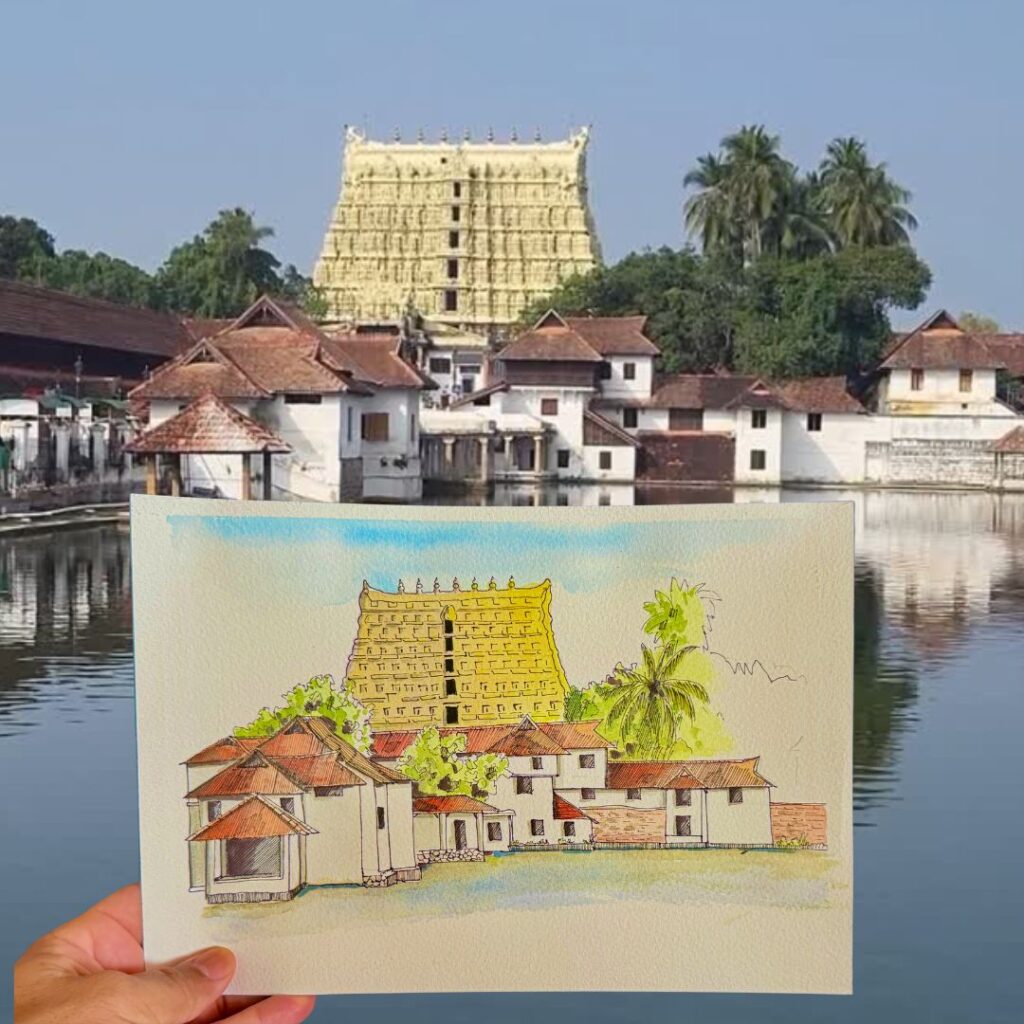
The first time I stood before the gopuram of Sree Padmanabhaswamy Temple, I was a schoolboy on a class trip, more interested in my friends than in history. That was forty-five years ago. What stayed with me from that day is strange and fragmentary. I remember the gopuram catching the light, gold and glowing, almost too bright to look at directly. I remember a massive door, the kind that makes a child feel very small. And I remember glancing around at the sloping roofs of the old houses surrounding the temple, tiled and weathered, though I could not tell you now what they looked like in any real detail. That is all. A flash of gold, a door, some rooftops. Everything else has faded.
Last month I went back, this time with a sketchbook instead of a school uniform. I went specifically to draw, to sit somewhere quiet near the temple and try to capture some of what I had only half noticed as a boy. It is a different way of seeing a place. When you sketch something, you cannot rush past it. You have to look at the proportions of the gopuram, the rhythm of its tiers, the way the carved figures repeat and vary as they rise. I spent a long time just looking before I made a single mark.
As I sketched, I kept thinking about how many centuries of people had stood in this same spot before me. The temple is believed to date back to around the 8th century, although local tradition and the old scriptures place its origins much further back, into the realm of legend. The deity inside, Vishnu reclining on the serpent Ananta with a lotus rising from his navel, gives the temple its name, and that image of stillness seemed to settle over the whole place while I was drawing.
The mix of Kerala and Dravidian architecture became much clearer once I started sketching. From a distance, the gopuram dominates everything, tier after tier of carved figures rising up. But when you spend an hour drawing, you begin to notice the other parts too, the long stone corridors, the sloping roofs, the details that feel shaped by Kerala’s own climate and craftsmanship rather than borrowed from elsewhere.
I also found myself thinking about the Travancore kings while I worked, especially Marthanda Varma, who is remembered for expanding and enriching the temple until it became one of the grandest in India. He is said to have surrendered his own kingdom to the deity, calling himself a servant of Padmanabha from then on. That bond between the royal family and the temple has continued for generations, right down to today, with the family still involved in its affairs.
That dedication of the kingdom to the deity is really where the wealth began. For centuries afterward, donations from devotees, rulers and traders piled up in the temple’s underground vaults, largely untouched and forgotten by most people outside the royal family. When the Supreme Court ordered the vaults opened in 2011, five of the six were unsealed, and what came out was staggering: 800 kilograms of gold coins, an 18-foot pure gold chain, a 500 kilogram gold sheaf, and a golden throne studded with diamonds, among countless other items. The combined value of these vaults is usually estimated somewhere between 18 and 22 billion dollars, making this the richest temple in the world. And then there is Vault B, never opened, said to be guarded by ritual and tradition, with some believing it could hold even more than everything found so far.
Sketching the temple felt like closing a loop that opened forty-five years ago. The boy who saw only a golden gopuram and a big door has become a man who can finally sit with this place, take his time, and try to put some of its weight and light onto paper. The gold is still there, and so is the door. But now I know there is so much more underneath, both in the stone and in the ground beneath it.