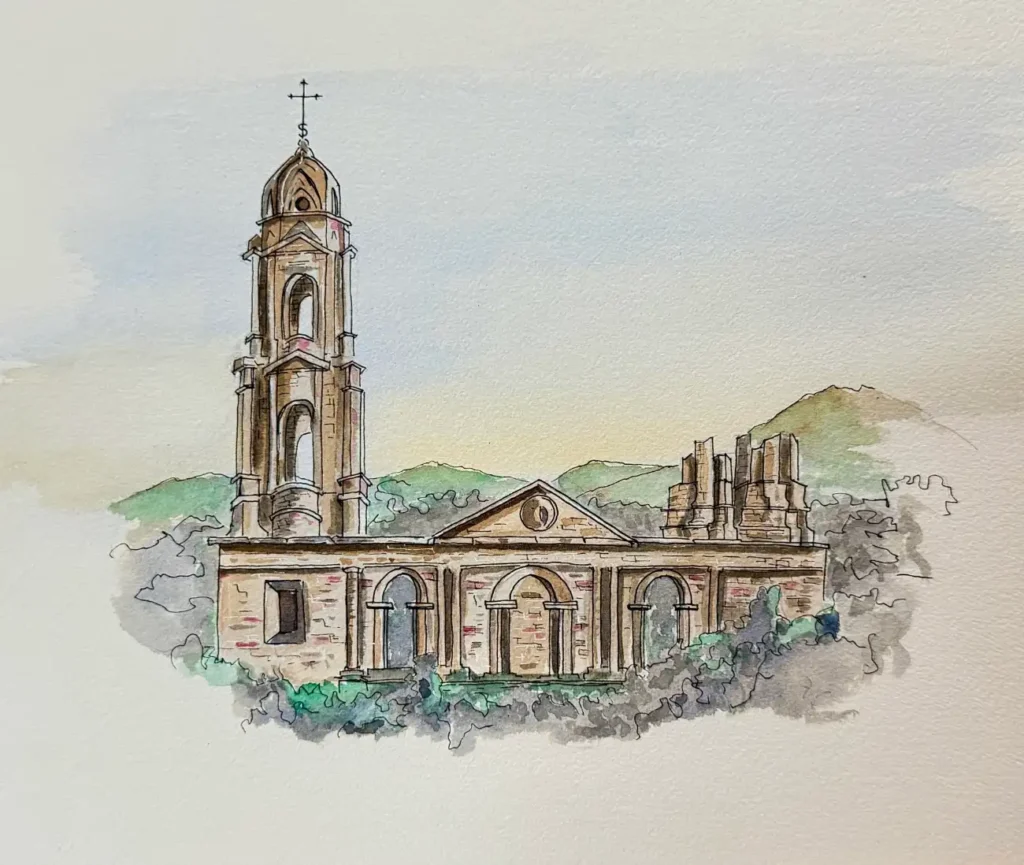
There is a church in Mexico that stands in the middle of a black volcanic wasteland, roofless, half buried, and completely alone. Locals call it the lava church. I call it one of the most extraordinary buildings I have ever sketched. This is the story of San Juan Parangaricutiro, a church that survived a volcano that swallowed an entire town around it. It is also the story of a community that lost everything except what mattered most to them.
Where It Is
The church sits in the state of Michoacán, in western Mexico, near a small village called Angahuan. This whole area belongs to the Purépecha people, an indigenous community that has lived and farmed this land for centuries. Before 1943, this was ordinary farmland. Corn fields, small homes, a town center, and a church at its heart, the way most Mexican villages are built around their faith. Nothing about this place suggested it was about to become one of the strangest landscapes on earth.
The Volcano That Changed Everything
On February 20th, 1943, a farmer named Dionisio Pulido was working his cornfield when the ground beneath him began to crack and smoke. Within a day, a new volcano had been born right there in his field. It came to be known as Paricutín. What followed was nine years of continuous eruption. Lava crept slowly but relentlessly across the land, burying farms, homes, and roads under a thick black crust of volcanic rock. Almost the entire town of San Juan Parangaricutiro disappeared under it. The community was evacuated in time, and remarkably, no one died from the lava itself. But their town, their homes, and generations of history were gone in a matter of years, sealed under solid black stone.
How the Church Survived
Out of everything the lava consumed, one structure held its ground. The town’s church. The lava crept up to its walls and stopped just short of erasing it completely. Today, the building stands roofless, its walls exposed to the sky, but it is still standing on top of the volcanic rock rather than buried beneath it. It is one of the very few remnants of the old town that you can still walk up to and touch. Nobody fully agrees on why the church survived when everything else did not. Some point to the thickness of its walls, others to sheer luck in how the lava flow moved around it. Either way, it has become a powerful symbol for the region. Proof that faith, or at least the physical home of it, can outlast even a volcano.
Why I Was Fascinated by This Church
I sketch churches for a living, or at least that is what I am building toward, and I look for buildings with a story that goes beyond architecture. The first time I saw a photograph of this church, tower rising out of a sea of black rock, I could not stop looking at it. It is not a pretty church in the traditional sense. It has no roof, no restored facade, no polish. But it has something most churches do not. Proof of survival written directly into its walls. Dark volcanic stone all around it, small patches of moss and plant life slowly creeping back over the rock, and here and there, flashes of the church’s old red brick still visible through the black. Destruction and quiet renewal sitting side by side.
That contrast is exactly what pulled me toward this church, and exactly what I wanted to capture on paper.
My Mission of Sketching Churches
This church is part of a larger project I am working on, where I aim to sketch three hundred iconic churches from around the world. Not the most famous cathedrals necessarily, but churches that carry a story worth telling, whether that story is about architecture, culture, survival, or faith. San Juan Parangaricutiro fits that mission perfectly. It is not just an old building. It is a record of what a community chose to save when nature gave them almost no choice at all.
The Current Situation
The community itself did not disappear along with their old town. They relocated and built a new settlement nearby, called Nuevo San Juan Parangaricutiro. And they carried their faith with them in a very literal way. For generations, this community has held deep devotion to the Señor de los Milagros, the Lord of Miracles. When they evacuated the old village, they carried that sacred image out with them. Today, it rests in the Sanctuary of the Señor de los Milagros in the new town, and the pilgrimage to honor it continues every year.
Meanwhile, the old lava church remains standing exactly where the eruption left it, now a recognized historical site and a place of quiet pilgrimage in its own right. It has become one of the more unusual tourist landmarks in Michoacán, drawing visitors who want to see, in person, what it looks like when a volcano meets a community’s faith and does not fully win.
How to Reach the Lava Church
If you are coming from Mexico City, Uruapan is your practical base for this trip, roughly four and a half to five hours away by road. From Uruapan, it is another forty five minutes to the village of Angahuan, which acts as the gateway into the volcanic landscape and the church itself. From there, most visitors continue on foot or by horseback across the old lava field to reach the church. I would strongly recommend hiring a local guide for this part of the trip. Beyond just navigating the terrain, a good guide can walk you through the volcano’s history, the Purépecha culture of the region, and the traditions that grew out of this whole event. It adds a layer of understanding you simply cannot get from photographs or articles alone.
Final Thoughts
What stays with me about this church is not just the volcanic rock or the dramatic backstory. It is the fact that a community facing total loss chose to save what mattered most to them, and rebuilt their lives around it. The lava buried their village. It never buried their story. And that is exactly what I was trying to put down on paper when I sat with my sketchbook in front of this church.