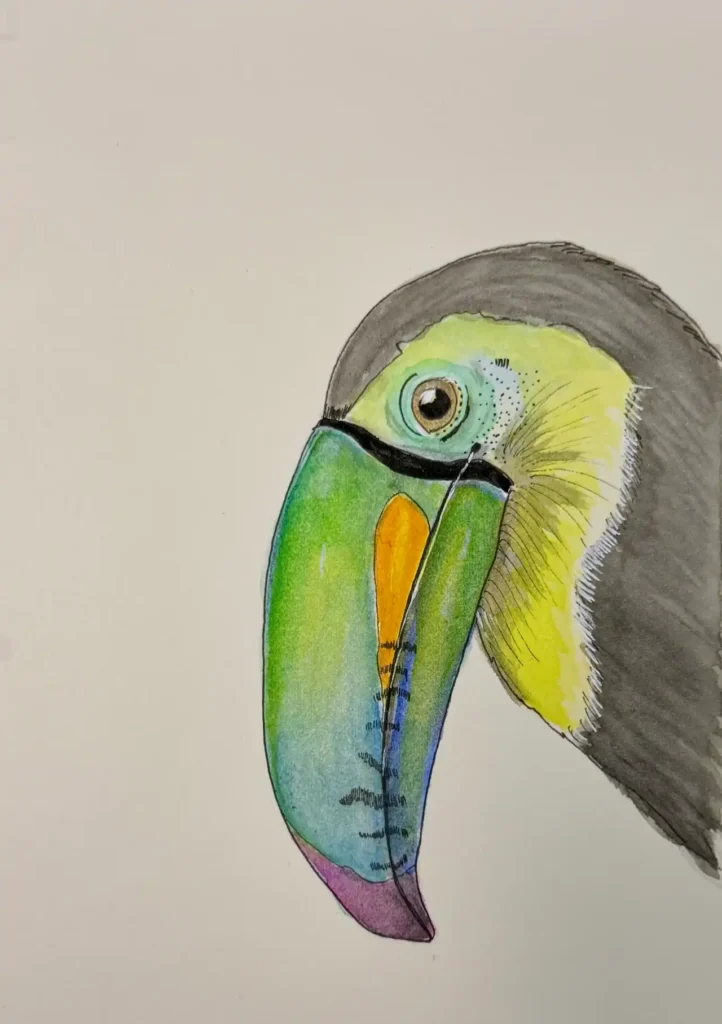
Over the last twenty years, photographing birds across Asia and Africa, I have kept returning to hornbills. Not exclusively. There have been too many other birds, other forests, other mornings with a camera pointed at something unexpected. But hornbills have remained a favourite subject, the kind of obsession that builds slowly and doesn’t announce itself until you count back and realise you have now photographed sixteen species across two continents. The Great Indian Hornbill in the Western Ghats, the Helmeted Hornbill in Thailand, the Philippine Hornbill in Palawan, and others scattered across forest trips that blur together in memory except for the birds themselves. So when I found myself standing in front of a Keel-billed Toucan at the Zoologischer Garten in Zurich a few years ago, hornbills were naturally the frame through which I first looked at it.
That frame didn’t last long.
The bill stopped me. I had seen photographs, everyone has, but photographs flatten colour, and the bill of a Keel-billed Toucan is not a flat thing. Green, orange, red, yellow, blue, bleeding into each other across that long curve without hard edges or clean borders. I had my camera with me. For a while I didn’t raise it. I just looked. There is a particular kind of stillness that comes over you in front of a bird that exceeds your expectations, and I have learned over the years not to interrupt it with the camera too quickly.
The bill is keratin built over a honeycomb internal structure, which keeps it surprisingly light despite its size. It also works as a thermal regulator, with blood flow through the bill increasing or decreasing to help the bird manage body heat in the tropical forest. A cooling system built into the face. Standing there I thought about hornbill casques, those hollow structures on the upper bill that serve their own purposes: display, resonance, species recognition. Two entirely unrelated families, separated by continents and millions of years, both arriving at elaborate structures on the bill for reasons that are still not completely understood. That kind of convergence is part of what keeps drawing me back to both.
Toucans belong to Ramphastidae, hornbills to Bucerotidae. No shared ancestry. But the ecological overlap is considerable. Large fruit-eating birds working through forest canopies, carrying seeds across distances that matter for forest regeneration, playing a role in forest health that goes well beyond their own survival. Knowing one family gives you an instinctive read on the other. What is harder to anticipate is the difference in personality, for want of a more scientific word. The hornbills I have photographed tend towards deliberateness, a kind of unhurried weight in the way they move and sit. The Keel-billed Toucan in Zurich was restless, fidgety, constantly working that bill even when it wasn’t eating. A different kind of energy entirely, and one I wasn’t expecting.
The Keel-billed Toucan, Ramphastos sulfuratus, is the national bird of Belize, common across lowland rainforests and forest edges through much of Central America. It is not the largest member of its family. That distinction belongs to the Toco Toucan of South America, which holds the record for the largest bill relative to body size of any bird in the world, and yet that bill remains remarkably lightweight, the same honeycomb engineering at work. At the smaller end of the family are the toucanets, birds like the Emerald Toucanet that inhabit cloud forests and mountain vegetation, moving quietly through dense cover and genuinely difficult to track down. Some of the most visually arresting members of the family are the mountain toucans of the Andes. The Plate-billed Mountain Toucan, with its vivid blue facial skin and layered bill colours, is considered by many to be among the most beautiful birds in the Neotropics. The Curl-crested Aracari, with its strange curly crown feathers, looks like a bird that simply ignored the conventions everyone else was following.
There are around forty species in the toucan family in total, ranging across tropical and subtropical forests from Mexico down through much of South America. Several are highly sought after by birdwatchers and wildlife photographers, drawing people into remote Andean forests and lowland rainforests that they might not otherwise visit. In that sense the family does something beyond its ecological role. It pulls people towards places and habitats that need attention and protection.
The diet is predominantly fruit, supplemented by insects, small reptiles, eggs, and nestlings when available. The seed dispersal role mirrors what hornbills do across Asia and Africa, both families maintaining the forests they depend on in ways that are invisible until they are gone.
I have not yet seen a Keel-billed Toucan in the wild. Costa Rica, Belize, Panama, those are still ahead of me, trips that exist at the moment as intentions rather than bookings. What I took from Zurich was the colour, specifically the way it felt excessive, almost implausible for a living bird. The kind of colour you would second-guess in a painting, wondering if it was too much. I have had that feeling before. The first time I got close to a Great Indian Hornbill in the Western Ghats, there was a moment of genuine disbelief that something so visually extreme could simply be going about its morning in an ordinary forest, unbothered, indifferent to how remarkable it looked. The Keel-billed Toucan gave me that same feeling, unexpectedly, through zoo glass in Switzerland on an afternoon I hadn’t anticipated remembering.
That is enough reason to go looking for it properly.