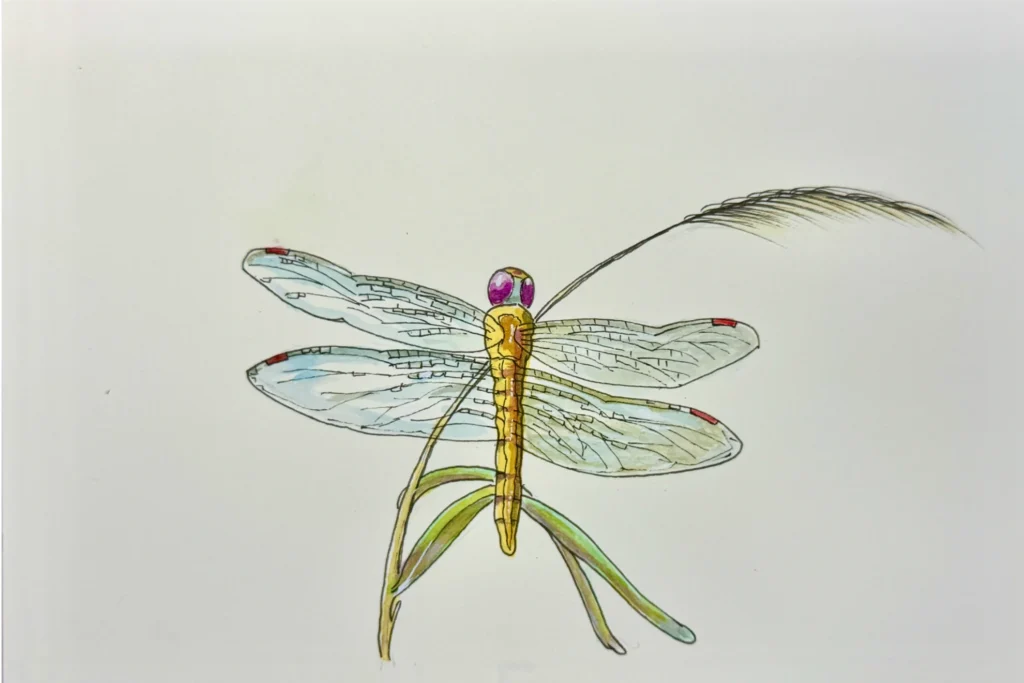
Every monsoon, Globe Skimmers arrive in India on wind systems older than civilisation itself.
The Dragonflies of My Childhood
I grew up in a rubber plantation in Kerala, in the South India. During the monsoon months, the landscape changed almost overnight. The ponds overflowed into the grass, the laterite soil turned dark, and the smell of wet leaves drifted through the house from morning till evening. Somewhere in that changing season, they arrived.
Golden dragonflies.
They flew swiftly above puddles, ponds, playgrounds, and narrow plantation roads. Sometimes they hovered quietly over standing water. Sometimes they circled our football ground in groups after a sudden evening shower. We hardly paid attention to them as children. They were simply part of the rains, like frogs calling at night or damp clothes refusing to dry indoors.
Only much later did I realise that some of those dragonflies may have travelled from Africa.
That thought still feels unbelievable to me. A delicate insect smaller than a finger crossing oceans with the monsoon winds and reaching Kerala before the heavy rains settle over the land.
Long before humans crossed these seas, these dragonflies already did.
The Travellers of the Monsoon
The species is called the Globe Skimmer, also known as the Wandering Glider. Scientifically, it is known as Pantala flavescens. Scientists believe its migratory cycle across Africa, the Indian Ocean, India, and parts of Asia may exceed 8,000 kilometres through multiple generations.
Some may cross more than 4,000 kilometres of open ocean between East Africa and India using seasonal wind systems linked to the monsoon.
Kerala has always waited for travellers carried by these winds. Arabs, Chinese traders, Portuguese sailors, Dutch merchants, and the British all arrived through the monsoon routes of the Arabian Sea. The history of Kerala itself is deeply tied to wind, rain, spice, and the sea.
But somewhere above those ships and ambitions, these dragonflies were already travelling silently between continents.
No maps. No ports. No empire.
Just wind.
The more I read about them, the stranger the story became. They are not merely drifting randomly with the weather. They follow rain because the monsoon creates temporary pools of water across the landscape. Small puddles beside roads, flooded plantation corners, paddy fields, and shallow ponds suddenly become nurseries for the next generation.
The dragonflies arrive, breed quickly, and the larvae develop at remarkable speed before the tropical sun dries the water again.
Their migration is tied directly to survival.
Some studies even suggest that Globe Skimmers may fly at altitudes of several thousand metres to catch strong seasonal air currents. It is astonishing to imagine such a small creature navigating weather systems on a continental scale.
And yet, when one settles quietly on a reed beside a pond, it looks fragile enough to disappear in a gust of rain.
Sketching the Globe Skimmer
That contradiction is what drew me toward sketching this species.
I am not a trained artist, and I do not sketch to become one. I sketch because drawing forces me to slow down and notice things properly. When you sketch a dragonfly, you begin observing movement differently. Even when perched, the insect is never completely still. The reed bends with the wind, the wings tremble slightly, and the body keeps adjusting its balance.
You are not merely drawing an insect.
You are trying to capture a moment between wind and stillness.
For this sketch, I kept the composition simple. A curved reed stem, a few leaves, empty monsoon sky, and the dragonfly resting quietly in the middle of it all. I avoided filling the paper with too much detail because monsoon landscapes are often more about atmosphere than objects. Humidity itself becomes part of the scenery.
As I worked on the sketch, I realised how different drawing feels compared to taking photographs. A sketch carries hesitation, correction, memory, and observation all together. Even imperfect lines somehow preserve the feeling of the moment.
Perhaps that is why old field journals still feel alive when we look at them.
Why Everyone Should Keep a Nature Sketchbook
One thing worries me slightly about modern life. We are documenting everything, yet remembering very little. Thousands of photographs disappear into phones and hard drives without ever being revisited.
A sketchbook behaves differently.
When you draw something, even badly, it stays with you. You remember where you were sitting, how the weather felt, and what caught your attention that day. A rough sketch of a dragonfly beside a pond can sometimes carry more memory than fifty perfect photographs scrolling past on a screen.
That is why I encourage people to sketch.
Not to become artists. Not to impress anyone. Simply to slow down a little.
You do not need expensive materials. You do not need training. A pencil, a pen, and a sheet of paper are enough. Perhaps you begin with a dragonfly after the rains. Perhaps a crow near your window, a fishing boat, an old building, or a tree near your house.
Over time these pages become personal records of attention.
That matters.
Download the Sketch and Fact Sheet
Along with this blog, I have included a downloadable sketch outline and a small fact sheet about the Globe Skimmer and its migration. You can print them, colour them, keep them in a folder, or perhaps begin a small journal of natural history observations from your own surroundings.
You do not have to draw perfectly. Nature itself is rarely perfect in straight lines.
Children may especially enjoy collecting them over time.
The Next Time the Monsoon Arrives
Every year, these dragonflies continue a journey that may have begun millions of years ago. They arrive quietly over ponds, playgrounds, paddy fields, and village roads across Kerala, just as they did during my childhood in the rubber plantation.
Most people still do not know where they came from.
Perhaps that mystery is part of their beauty.
The next time you see a golden dragonfly circling above wet ground during the monsoon, pause for a moment before walking away.
It may have crossed an ocean to be there.