Trogons
I have always found trogons a bit unusual. Not because they are rare, but because of how they behave. They do not move much. They sit still for long stretches, almost like they are part of the branch. You can walk past one and never notice it. Only when you slow down, it begins to appear.
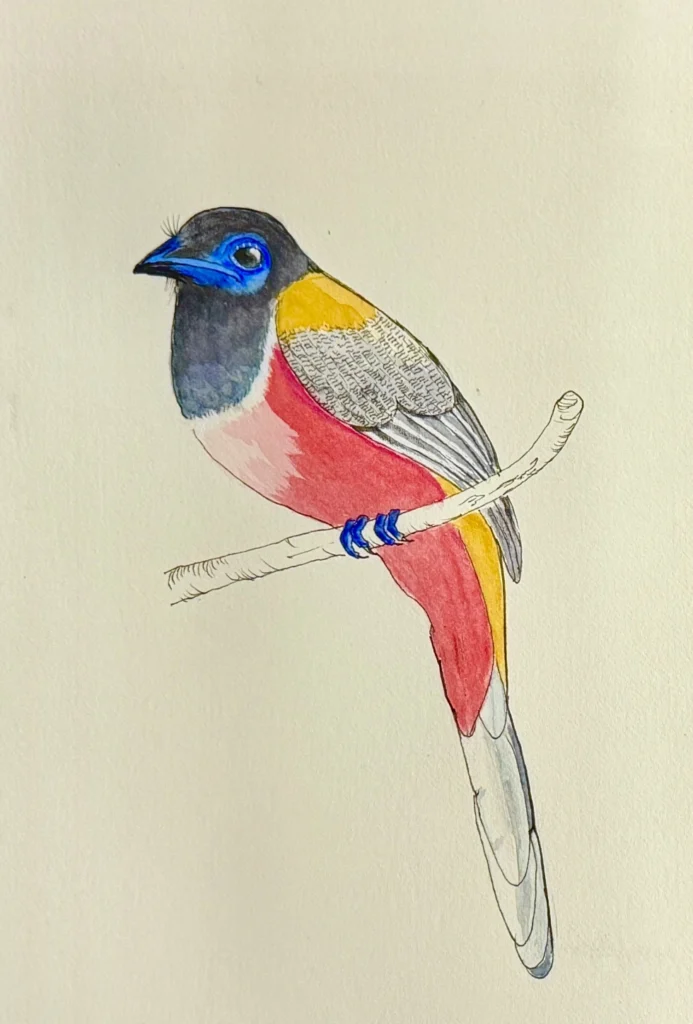
I have seen trogons in different parts of the tropics, but the one that stayed with me is the Malabar Trogon from the Western Ghats. It is not a loud bird. It does not draw attention. It just sits there, quietly. The red on the belly, the dark head, the long tail, everything feels balanced. Nothing feels hurried about it.
If someone asks me where to see it, I usually think of places like Thattekkad, near Kochi in South India where the forests are dense and alive, or deeper stretches such as Silent Valley, and even parts of Wayanad where the canopy still holds. But even in these places, you do not go and “find” the bird. You spend time, you wait, and sometimes it allows you to see it.
And when it does, it stays with you in a way that is difficult to explain.
My first Malabar Trogon was in Thattekkad, about twelve years ago. I was there with a fellow birder. It was an afternoon, and the weather was turning. You could feel the rain coming. The forest had gone quiet in that way it does before a shower.
We tried the call once.
It appeared.
Not with any drama. It just came and sat on a branch, as if it had always been there. What stayed with me was the deep red on the belly and a white necklace on its neck, sitting quietly in the shade.
The rain started slowly. We continued photographing, trying not to rush. After a few minutes, both of us were getting wet. The light was dropping. The forest was changing.
The bird did not move.
It stayed there through the drizzle. Calm. Unbothered. Almost like it had decided to stay with us for a while.
That moment has stayed with me more than many others. Not because of the photograph, but because of the stillness of it.
Years later, when I try to sketch this bird, I realise I am not really drawing the bird. I am trying to return to that moment.
You can search for reference images of the Malabar Trogon and draw along, or, if you prefer, you can download my sketch as a PDF from my website and follow at your own pace.
I start with a simple outline. Just the shape. The long tail helps to place the bird. I do not go into details at the beginning.
For colours, I use cerulean blue, cadmium red, burnt sienna, and yellow ochre, with a touch of crimson and purple. This is ink and wash, so I use watercolours. If not, pencils or crayons will also work.
I begin with the belly. A light wash of water, then a soft red. I let it sit. Then I move to the head with cerulean blue. Then the wings. I come back again and build slowly, one layer at a time.
I keep a bit of blue around the eye and the beak. That matters for this bird.
At the end, I deepen the red slightly and add a few quiet tones. I stop there.
It does not have to be perfect. It only needs to remind me of what I saw.
You may download the Malabar Trigon sketch form the below link and sketch along.
Download PDF Sketch from here: