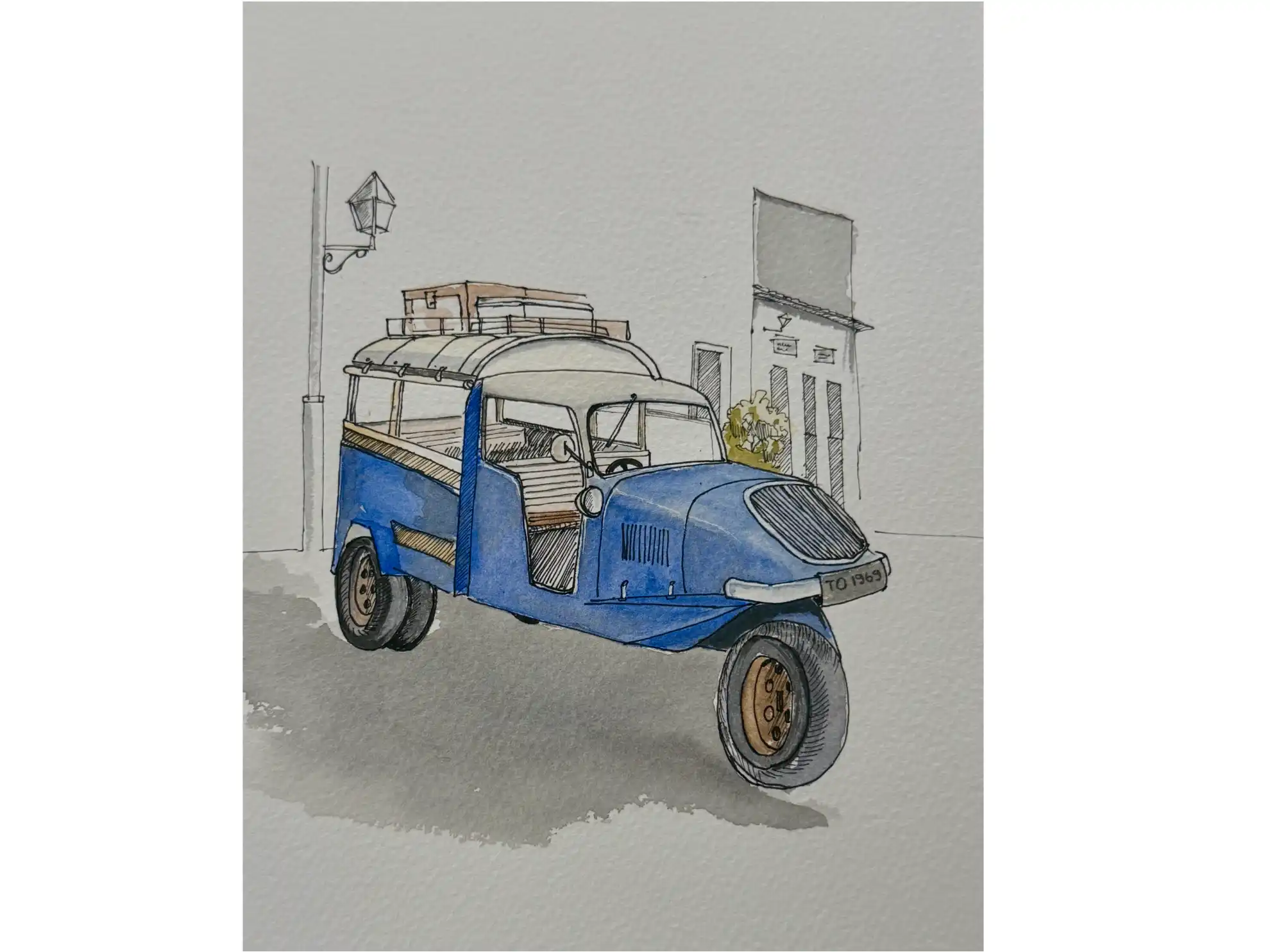
“I can tell you one thing,” Martin’s father said, standing beside the truck with his hands in his pockets. “This is better than a Mercedes.”
Martin burst out laughing.
His father didn’t.
That was my introduction to a Henschel Tempo three-wheeler on a sunny afternoon outside Munich.
Martin and I have been friends since our advertising days in Dubai, which is probably why we spend most of our time together looking at things that have nothing to do with advertising. Photography, sketching and old machines seem to occupy far more of our conversations these days than campaigns and deadlines.
I was in Frankfurt last year for a meeting when Martin suggested I come down to Bavaria and spend a few days with his family. It sounded far more interesting than sitting alone in a hotel, so I happily agreed.
A few days later we were driving through the countryside outside Munich towards his parents’ home.
After lunch, Martin asked if I wanted to see something interesting.
His father smiled and disappeared briefly into the house. When he returned, he was carrying a ring of old keys. Without saying much, he motioned for us to follow him.
We crossed the yard and walked towards a detached garage. Martin unlocked the door and pushed it open.
Inside was a small three-wheeled truck that looked as though it had wandered out of a black-and-white photograph.
The first thing that struck me was its size. In photographs, old commercial vehicles often appear larger than they really are. Standing beside this one, I realised how compact it was. The front wheel sat alone beneath the nose, while the cargo bed behind looked scarcely larger than the bed of a modern utility vehicle.
It was painted in a soft shade that had clearly been cared for over the years. Nothing about it suggested a museum piece. It looked ready to start work tomorrow morning.
Martin’s father walked around it slowly as we talked. Every now and then he would point out a detail. He showed me a latch, a badge, a repair his own father had once made. The conversation drifted between German and English. Sometimes Martin translated. Sometimes he didn’t need to.
You could tell this vehicle mattered to him.
What interested me most was that he never spoke about it as a collector’s item. He spoke about it as people speak about an old family tool.
That perhaps explains the affection many Germans still have for the Tempo.
The company was founded in Hamburg by Oscar Vidal in the 1920s and became known for producing small, practical commercial vehicles. Long before logistics became a fashionable word, these little machines were moving bread, milk, tools and produce around towns and villages across Germany.
Later the company passed through the hands of Hanomag and Henschel, which is why the vehicle in Martin’s garage carries the Henschel Tempo name.
Yet standing there, listening to stories, the corporate history felt secondary.
What stayed with me was the image of thousands of small businesses depending on vehicles like this. Bakers loading trays before dawn. Farmers heading to market. Mechanics carrying parts between villages. Nobody bought a Tempo to impress the neighbours.
It had a job to do.
As someone who enjoys sketching old vehicles, I was already mentally reaching for a pen. The proportions were wonderfully awkward. The single front wheel gave it an almost cartoon-like appearance from some angles. From others it looked surprisingly purposeful.
At one point I found myself staring at a crude weld beneath the driver’s door. It wasn’t neat, and it had been painted over several times. I asked about it, assuming it was some factory quirk. Martin’s father shook his head and launched into a story I only half understood about a gatepost, a winter morning and his father being in a hurry. By the end everyone was laughing except me, because I still wasn’t entirely sure what had happened.
The weld stayed in my sketch longer than the rest of the truck.
Eventually it was time to leave. Martin locked the garage and we headed back towards the house. His father took one last look at the truck before following us.
On the drive back to Munich, I kept thinking about his remark.
“This is better than a Mercedes.”
I still don’t know exactly what he meant by it. Maybe he was joking less than Martin realised. Maybe he was comparing memories rather than machines.
The little Tempo had spent decades doing exactly what it was built to do. It had carried loads, survived changing fashions and somehow found its way into the twenty-first century with its dignity intact.
As the motorway signs for Munich began to appear, I found myself wondering whether anyone in the family had ever seriously considered selling it. I never asked.
Perhaps I didn’t want to know the answer.