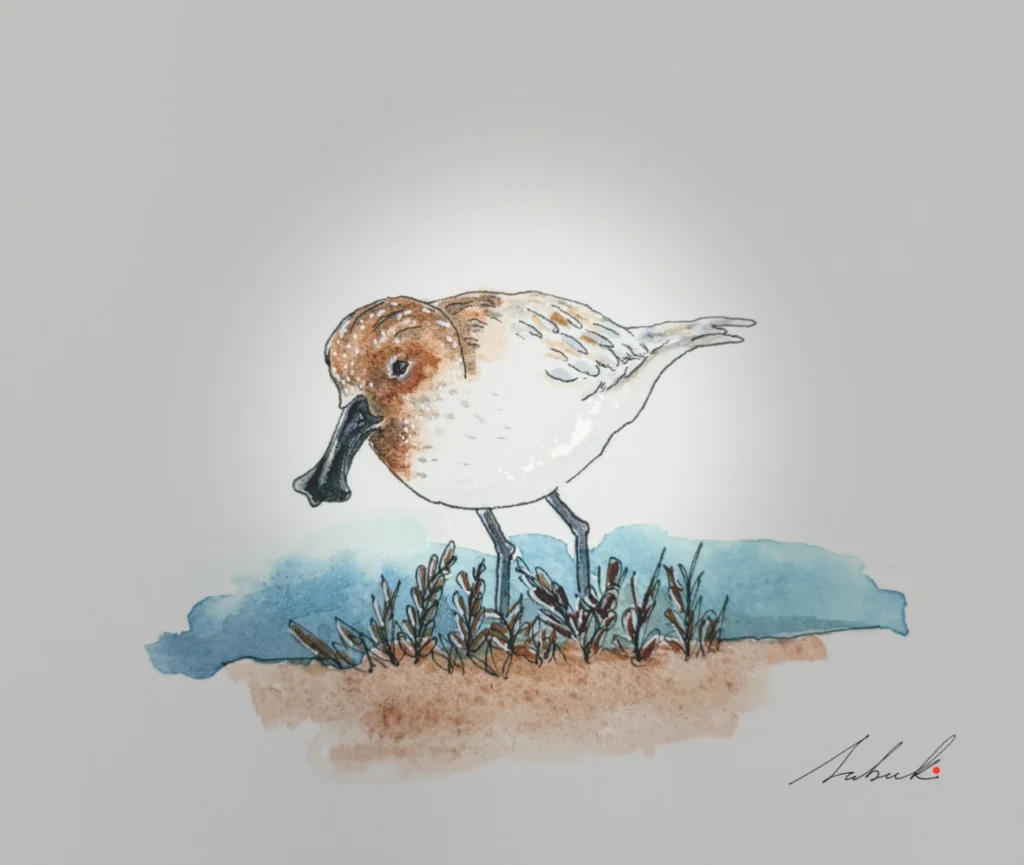
I still remember the exact moment I saw my first one — 7:30 in the morning, ankle-deep in the mud at Pak Thale on Thailand’s Phetchaburi coast, scanning through what felt like ten thousand shorebirds and hoping one small, oddly-billed sandpiper was somewhere in that mess. It took hours. My 500mm lens wasn’t nearly enough at that distance, so I ended up borrowing a friend’s spotting scope just to actually lay eyes on it. When it finally turned — bill flashing that unmistakable spoon shape as it swept through the wet mud — I understood immediately why birders travel across the world for this one small bird.
That’s the Spoon-billed Sandpiper, Calidris pygmaea, and if you’re planning a trip to see or photograph one, here’s everything I’ve learned chasing this bird myself — plus where you’ll actually need to go to find it.
What Makes This Bird So Special
The Spoon-billed Sandpiper belongs to the Scolopacidae family — the sandpipers, snipes, and their relatives — but it’s the only shorebird on Earth with a spatulate, spoon-shaped bill. It isn’t decorative. The bird sweeps its bill side to side through soft mud, picking up tiny invertebrates that other shorebirds simply can’t feel or find. Watch one feed for even a minute and you understand why it’s unlike anything else on the flats.
It’s also one of the rarest birds alive. Current estimates put the population at roughly 200 breeding pairs, and that number has been declining by about 5% a year. Every bird that survives the winter and makes it back to breed is beating odds that get longer every season — habitat loss along the migration route and hunting pressure on parts of the wintering grounds have pushed this species right to the edge.
Where to See the Spoon-billed Sandpiper in Southeast Asia
Pak Thale, about two and a half hours southwest of Bangkok on Thailand’s coast, is where I saw mine, and it’s still the single most reliable wintering site anywhere. Birds start arriving in late October and stay through late March, but February — when I went — is when the odds are genuinely best, which is exactly why the specialist tour groups schedule their trips for that month too. You’ll share the mudflats with Great Knot, Red-necked Stint, Curlew Sandpiper, and, if you’re lucky, the equally endangered Nordmann’s Greenshank.
The other wintering site worth knowing about is the Gulf of Mottama in Myanmar, which holds a large share of the global population outside Thailand. Between the two, most of the bird’s known non-breeding range in Southeast Asia is covered, but Pak Thale remains the easiest and most accessible for a first trip.
One honest bit of advice: bring a scope, not just a long lens. I had a Canon 1D X with a 500mm and a 1.4x converter on me, and it still wasn’t enough to pick this bird out at that distance. You’re not photographing a bird that poses for you — you’re finding one needle in a haystack of ten thousand other shorebirds first, and only then trying to get close enough to shoot it.
Chasing the Breeding Plumage
Everything I saw at Pak Thale was in non-breeding plumage — pale, plain, easy to lose in a mixed flock. If you want the bird in its striking breeding colours, that burnt-sienna wash across the head and chest, you have to go much further: the Chukchi Peninsula in far eastern Russia, beyond Kamchatka, where the last breeding pairs nest each June and July near the village of Meinypilgyno. It’s remote, logistically demanding, and not a casual add-on to a trip — but for photographers set on capturing this bird at its most dramatic, it’s the only place on the planet to do it.
The Spoon-billed Sandpiper in India — Rare Beyond Rare
If you’re hoping to see this bird in India, keep your expectations honest. It isn’t a species you plan a trip around here the way you would in Thailand — it’s one you might get extraordinarily lucky with.
For decades, only two Indian sites had anything close to a reliable record: Chilika Lake in Odisha and Point Calimere in Tamil Nadu, and even those sightings were sparse and years apart. For a long stretch, the bird was practically a ghost on the Indian coastline.
Then, in April 2018, a single Spoon-billed Sandpiper was photographed at Frasergunge West Beach in the Sundarbans, West Bengal — the first confirmed photographic record from the state in modern times, and a genuine rediscovery for Indian birders. It’s still the most significant, best-documented sighting in the country, and it’s the place I’d point any serious birder toward if they wanted to try their luck on the Bengal coast. Satellite-tagged birds have since been tracked flying roughly 8,000 kilometres from their Russian breeding grounds down to that same stretch of coast — proof the birds still pass through India, even if actually laying eyes on one remains a matter of patience, timing, and no small amount of luck.
My Advice for Fellow Travelers
If seeing this bird matters to you, go to Thailand first. Pak Thale in February gives you the best realistic odds anywhere on the planet, and you get to watch a Southeast Asian mudflat working at full strength along the way. Treat India as a bonus chase, not a plan — visit the Sundarbans or Chilika if you’re already birding there in winter, but don’t build a trip around it. And wherever you go, don’t just carry a camera. Carry a scope, carry patience, and be ready to spend hours working through flock after flock of birds that all, at first glance, look exactly the same.
I’m working my way through 200 rare and endemic birds of Asia in my own sketchbook right now, one at a time, and the Spoon-billed Sandpiper was one I’d wanted on the page for years before I finally got my chance. Some birds are worth the wait.