There are churches built in city centres, churches hidden away in forests, and churches carved straight into mountainsides. And then there is Katskhi.
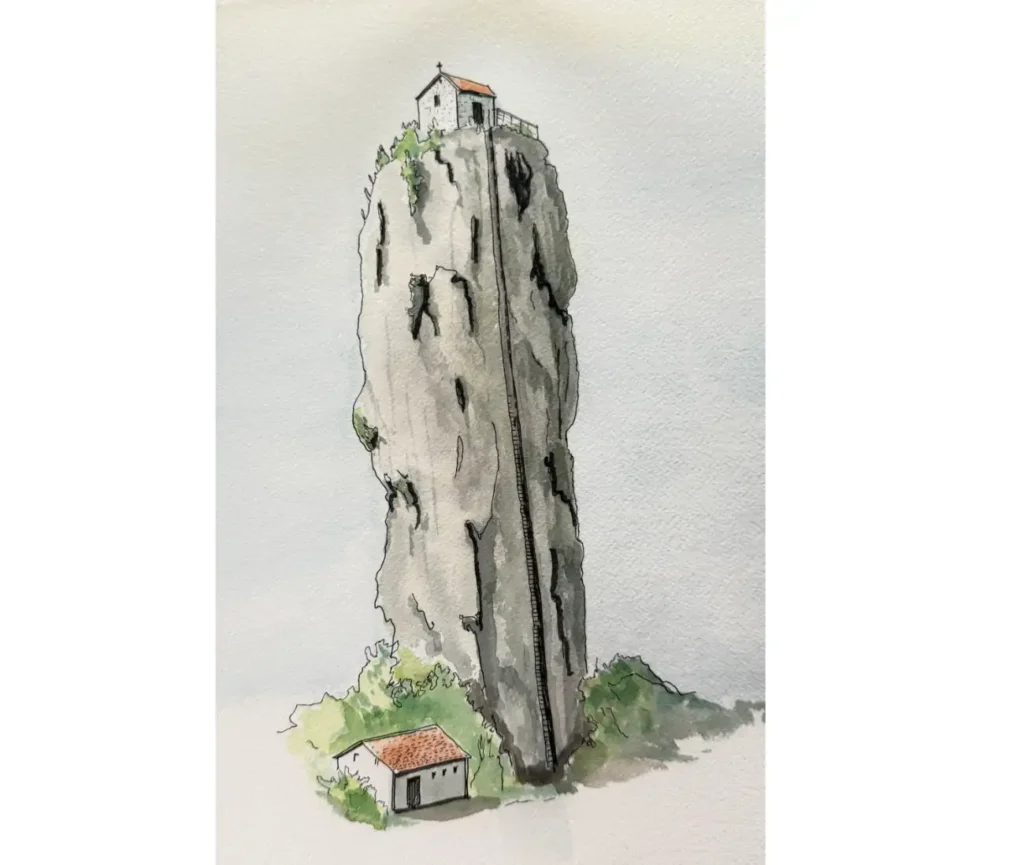
In western Georgia, in the foothills of the Caucasus, a limestone pillar rises about forty metres straight up from the surrounding valley. On its narrow summit sits a tiny Georgian Orthodox church and a small monastic complex. From the ground, the church looks almost too small to be real. The rock is enormous. The building on top of it is tiny. And it’s that tiny building, sitting where it really has no business sitting, that gives this place its meaning.
If you’ve watched my video on Katskhi Pillar, this post fills in what the sketch didn’t have time to cover: where it actually is, how to reach it, what you can and can’t see when you arrive, and the history that makes this one of the strangest churches in the world. And if you haven’t watched it yet, it’s linked below — the video shows the sketch coming together in real time while I talk through the story.
Where is Katskhi Pillar?
Katskhi Pillar sits in the Imereti region of western Georgia, close to the town of Chiatura. To be clear, this is Georgia the country in the Caucasus, not the American state of the same name.
The pillar rises from the ground just outside the village of Katskhi, about five kilometres from Chiatura, which itself lies roughly 200 kilometres from Tbilisi. If you’re coming from the capital, the drive takes around three hours. From Kutaisi, it’s a much shorter run, closer to ninety minutes.
The road out of Tbilisi runs west, past Zestaphoni and on towards Chiatura. The countryside gets steadily wilder the further you go, and at some point on that final stretch, the pillar simply appears above the treeline, well before you reach it.
Getting there without your own car
You don’t need to hire a car, though it makes the day easier. From Tbilisi, a marshrutka (shared minibus) runs to Chiatura roughly once an hour from the Didube bus station, taking about three hours. From there, a taxi to the pillar and back costs around 30 lari, and some drivers will stop at the older Katskhi Monastery nearby if you ask.
From Kutaisi, a minibus to Katskhi village is the simplest route. Public transport works but isn’t especially convenient, so a private car or taxi tends to be easier if you want to see more than just the pillar. Day tours also run from both cities, pairing Katskhi with Chiatura’s Soviet-era cable cars.
The pillar itself
Katskhi Pillar is a natural limestone monolith, not a man-made tower, standing at roughly forty metres. Its summit is small, but it holds the remains of a genuine religious complex: a church, a crypt, a handful of monastic cells, and even a wine cellar.
The original buildings on top date back to around the ninth century, though the site was abandoned by roughly the 1400s and left to fade into local legend for the next five hundred years. At the base of the pillar stands a stone cross believed to date from the sixth century, tying the site to some of the earliest chapters of Georgian Christianity — an ancient cross at ground level, and a tiny monastery hanging in the sky above it.
Why anyone chose to live up there
What draws me to this church isn’t really the architecture. It’s the reasoning behind it. Katskhi Pillar became associated with stylitism, a tradition of Christian asceticism in which monks deliberately sought extreme isolation, sometimes living for years on top of stone columns. Researchers believe the hermitage was likely run by Stylites, an ascetic branch of early Christianity that took this pursuit of solitude to its most literal extreme. The practice took shape in the Christian world of Late Antiquity, particularly across Syria and the eastern Mediterranean.
At Katskhi, the height and total isolation of the rock gave monks a genuine physical separation from ordinary life. This wasn’t an adventure for its own sake. The distance from the world below was the entire point of being there.
Georgia’s Christian roots
Katskhi belongs firmly to the Georgian Orthodox tradition, and Georgia holds one of the oldest continuous Christian histories anywhere in the world, having adopted Christianity as its state religion back in the fourth century. The sixth-century cross at the base of the pillar connects this site to that early period, and the pillar itself carries its own local associations with the True Cross in Georgian tradition.
Five hundred years of silence, then a climb in 1944
Like a lot of old religious sites, Katskhi didn’t stay occupied. At some point the monastic community left, and the buildings on the summit fell into ruin. By the eighteenth century, when the Georgian historian and geographer Vakhushti Bagrationi was writing about the region, monks were no longer living up there at all. For generations after that, the summit was effectively unreachable, and what remained on top became more rumour than fact.
That changed in 1944, when a team of researchers finally climbed to the top and confirmed the ruins of the early medieval hermitage, giving historians their first real evidence of what had been built up there centuries earlier.
The monk who brought it back to life
Religious life returned to Katskhi in 1993, when a monk named Maxime Qavtaradze, who grew up in nearby Chiatura, climbed the pillar because he wanted to be closer to God. The buildings were restored between 2005 and 2009 with the help of a state grant, and Maxime has lived there ever since — the only permanent resident on the summit, and by most accounts, women are not permitted to make the climb up.
Can you actually visit?
Yes, and it’s easier than you might expect. You can drive or walk right up to the base of the pillar, and the church is clearly visible above you from there. There’s no entrance fee, and the grounds and small museum at the base are free to explore. A short, gentle walk from the car park takes you to a viewing area, and from certain angles along the trail you get a genuinely striking view of the whole pillar with the church perched on top.
What you cannot do is climb it. The ladder and access route belong entirely to the monastery, and reaching the summit is restricted to the resident monk. Looking up, rather than climbing up, is the real experience here.
Practical tips for your visit
- Bring water and snacks. There are no shops near the pillar, so stock up in Chiatura or Katskhi village first.
- Wear comfortable shoes. The walk from the car park is short but uneven in places.
- Aim for early morning or late afternoon, for better light and fewer crowds.
- Allow thirty to sixty minutes at the pillar, and half a day if combining it with Chiatura or the older Katskhi Monastery.
- Dress modestly. This is an active religious site, not a tourist attraction.
Kutaisi is the best base for accommodation, giving you easy access to Gelati and Mgvimevi Monasteries as well.
A few common questions
Is Katskhi Pillar worth the trip? Yes, for anyone interested in Christian history or unusual places. It sees far fewer visitors than sites like Gelati or Mtskheta.
Can tourists go inside the church at the top? No. The summit church is only accessible to the resident monk; visitors view it from the ground.
Is it a difficult walk? No. The path from the car park to the viewing area is short and manageable for most fitness levels.
How long should I spend there? Around thirty to sixty minutes for most visitors, longer if you want to sketch or take your time with the view.
Sketching Katskhi
When I sat down to draw this one, I didn’t start with the church. I started with the rock. The vertical face of the pillar gives the whole sketch its character, so I worked with loose ink lines and washes to suggest the uneven surface rather than capturing every crack and ledge. The church went in last, right at the top, with small, deliberate strokes that look almost fragile against the size of the stone beneath it.
A photograph shows you what a place looks like. A sketch makes you slow down and ask why it looks that way. At Katskhi, that question leads straight into thirteen centuries of religious history, and into the story of one monk who decided the best way to feel close to God was to leave the ground behind entirely.
Watch the full sketch
This post covers the history and the practical details, but the video is where you actually see the drawing take shape, ink stroke by ink stroke, while I talk through everything above. The link is right here — and if Church Sketchbook is the kind of thing you enjoy, subscribing means you won’t miss the next one.
Katskhi Pillar is Church Number 5 in my mission to sketch three hundred iconic churches from around the world. Up next is the Church of San Juan Parangaricutiro in Mexico, swallowed almost whole by a volcanic eruption and left standing in the middle of a lava field. A very different story, and I can’t wait to share it.