Sometimes a sketch begins with a memory
I do not remember the name of the port from which I took the ferry to Mykonos in 2003. I do not remember the exact route, the timetable or even the details of the journey. What I remember, quite clearly, is arriving in Mykonos, walking through the old streets of Chora and seeing a small white church against the blue of the Aegean.
That image stayed with me.
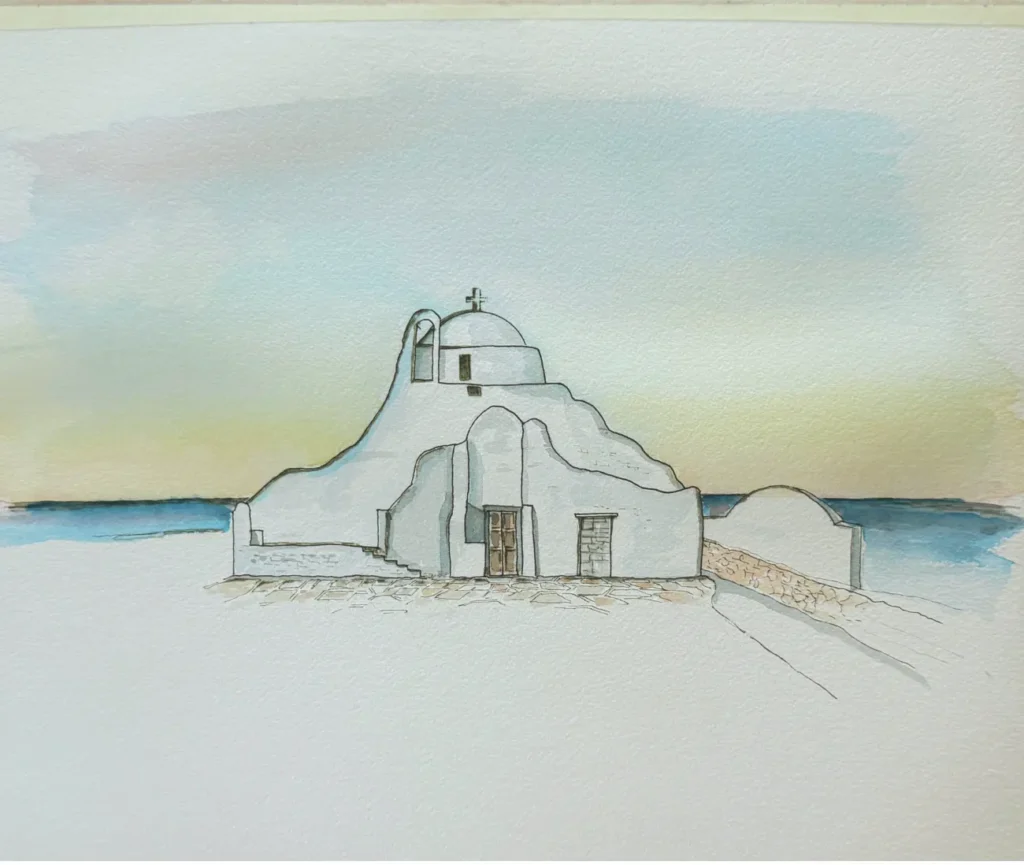
More than twenty years later, while working on my Church Sketchbook project, I found myself looking at photographs of Panagia Paraportiani and thinking about that first encounter. I had seen the church only once, but the memory of it had survived. So I decided to sketch it.
This is Church number four in my project to sketch 300 iconic churches around the world. And this particular sketch has become an exercise in memory as much as observation. I am not trying to reproduce the church photographically. I am trying to recover the atmosphere of that moment in 2003: the whitewashed walls, the intense Mediterranean light and the blue sea behind them.
That, for me, is one of the pleasures of travel sketching. A photograph tells us exactly what was in front of us. A sketch can tell us what remained in our minds.
Why Panagia Paraportiani is so unusual
Panagia Paraportiani is one of the most recognisable churches in Greece, but its appearance can be misleading. What looks like one small whitewashed church is actually a complex of five churches, built and altered over several centuries.
Four churches form the lower part of the structure, while the fifth church sits above them. This upper church is the one known specifically as Panagia Paraportiani and is dedicated to the Virgin Mary, or Panagia in Greek.
The four churches at the base are dedicated to Saint Eustathios, Saints Anargyroi, Saint Sozon and Saint Anastasia. The church of Saints Anargyroi is considered the oldest of the group, with origins at the end of the 14th or beginning of the 15th century, while the complex developed further during the 16th and 17th centuries.
This makes the church particularly interesting from a travel perspective. It was not conceived as a single architectural project. Instead, the present building is the result of several churches and structures developing together over time.
The result is wonderfully irregular. Curves, arches, walls and small architectural elements seem to overlap rather than follow a rigid plan. The church almost appears to have been shaped by the place itself.
It is this quality that I wanted to capture in my sketch.
The story behind the name
The name Paraportiani is closely connected to the medieval history of Mykonos.
The church stands beside a small north-western gate in the medieval wall of Chora. This gate was known as the paraporti, meaning a small side gate, and the church took its name from its position beside it.
The setting is therefore an important part of understanding the church. Panagia Paraportiani was not built as an isolated landmark for visitors. It developed within the medieval settlement of Mykonos, beside its defensive walls and close to the rocky coast.
The official history of the church describes the present complex as the product of both human construction and the passage of time. That is a useful way of looking at it. Its character comes not only from the original builders but also from the changes, additions and weathering that took place over many generations.
Today, it is one of the most photographed sights in Mykonos and one of the most recognisable examples of Cycladic church architecture.
Yet its significance is more than visual. It remains part of the Greek Orthodox tradition and belongs to the religious history of the local community.
My visit to Mykonos in 2003
I was travelling in the Greek islands in 2003 and had come to Mykonos from Santorini. I remember choosing to make the journey by boat because I specifically wanted to see Panagia Paraportiani.
The details of that trip have faded with time, but the church itself has not.
I remember walking through Chora and coming upon the church in the Kastro area. The contrast was striking: the intense white of the building, the blue of the sea and the hard Mediterranean sunlight.
There was something almost sculptural about it.
The church did not look like the grand European churches I had encountered elsewhere. It was small, asymmetrical and almost modest. Yet its position beside the sea gave it an extraordinary presence.
I think that is why the image stayed with me.
When I started this sketch more than twenty years later, I realised that I was not trying to reconstruct the exact building I had seen. My memory had already edited the scene. It had kept the things that mattered to me and discarded much of the rest.
What remained was essentially three things: white, blue and light.
Sketching Panagia Paraportiani
Sketching a white building presents an interesting challenge. It is tempting to add colour simply because the paper feels too empty, but that can easily destroy the sense of light.
With Panagia Paraportiani, the shadows are more important than the colour itself. A darker line under an arch, a slightly warmer wash on one wall or a small amount of blue reflected from the sea can give the white architecture enough definition without covering it in paint.
This is also why I do not approach my Church Sketchbook drawings as exercises in photographic hyperrealism.
I am interested in observation and memory.
When I sketch, I might use a thin line to describe an edge and a stronger line where I want the structure to feel more solid. Some lines can be slightly broken or uneven. I do not need every stone, every crack or every architectural detail.
The aim is to make the viewer recognise the place and, hopefully, feel something of the experience of being there.
With this church, I wanted the composition to retain the relationship between the white building and the Aegean. The sea is not simply a background. It is part of the identity of the place.
The religious identity of the church
Panagia Paraportiani belongs to the Greek Orthodox tradition and is dedicated to the Virgin Mary.
The church’s principal feast is associated with the Dormition of the Theotokos on 15 August, a major celebration in the Greek Orthodox calendar. A Greek Orthodox calendar specifically lists the Feast of Panagia Paraportiani in Mykonos on 15 August.
For travellers, this is worth knowing because 15 August is one of the busiest religious and holiday periods in Greece. It can be an interesting time to experience Greek Orthodox culture, but it is not necessarily the easiest time for someone looking for a quiet morning to sketch.
The church should also be approached as a place of worship rather than simply as a photographic landmark. Access to the interior can depend on church activity and local arrangements.
How to get to Panagia Paraportiani
Mykonos is part of the Cyclades, in the Aegean Sea, and is well connected with Athens.
The fastest option is to fly from Athens International Airport to Mykonos International Airport. The flight is roughly 50 minutes.
The alternative is to travel by ferry. Services connect Mykonos with Piraeus, the main port serving Athens, as well as Rafina, which can be particularly convenient for travellers arriving through Athens Airport. Journey times vary according to the vessel and service, so it is worth checking the timetable when planning the trip.
Once you reach Mykonos Town, the church is in the Kastro area of Chora, and the final part of the journey is on foot. This is actually one of the pleasures of visiting. Rather than arriving directly at the church by vehicle, you walk through the narrow lanes of the old town and gradually encounter the historic buildings around it.
The church is therefore best combined with a slow walk through Chora rather than treated as a quick stop on a sightseeing itinerary.
When should you visit?
For travellers who want to explore Mykonos at a slower pace, I would consider May, early June, September or the first half of October. These periods generally offer a better balance between pleasant weather, Mediterranean light and fewer visitors than the peak summer weeks.
August is a different experience. It is the height of the season, and 15 August is an especially important religious date across Greece. If your interest is in the religious life of the island, this could be a fascinating time to visit. If your priority is sketching quietly and spending time looking at the architecture, I would choose the shoulder seasons.
There is also one practical consideration that should not be forgotten: Mykonos is famous for its strong winds. If you are travelling by ferry, sea conditions can occasionally affect the journey.
What to look for when you visit
The obvious thing to do is to stand in front of Panagia Paraportiani and take a photograph. But I would encourage you to spend a little more time around it.
Look closely at the way the five churches have been combined. Notice the different curves and arches and the way the whitewashed surfaces catch the sunlight differently. Walk through the surrounding Kastro area and look at the relationship between the church, the old settlement and the sea.
Then step back.
The most memorable view is not necessarily the one that shows the most architectural detail. It is the one that shows why this church has become such an enduring image of Mykonos.
For me, that means the white church, the blue Aegean and the strong light.
Why this church belongs in the Church Sketchbook
The Church Sketchbook is not simply a collection of beautiful churches. I want each church to have something that makes me stop and look: a distinctive history, an unusual setting, an architectural story, a connection with a community or, sometimes, simply a memory that has stayed with me.
Panagia Paraportiani has all of these.
It has a medieval setting, a complex of five churches, a long Orthodox tradition and an unusual architectural form created over several centuries. It is also one of those places where the landscape is inseparable from the building.
But for me, the strongest reason is personal.
I first saw Panagia Paraportiani in 2003. I did not know then that, more than two decades later, I would be sitting at my desk trying to sketch the memory of that visit.
I cannot remember every detail of the journey.
I do remember the church.
And perhaps that is enough.
My sketch is not an attempt to recreate that day photographically. It is my way of recording what survived: the white walls, the blue sea, the Mediterranean light and the feeling of standing in front of something that looked deceptively simple but carried centuries of history.
Panagia Paraportiani is Church number four in my journey towards 300 iconic churches.
I have also prepared a Church Sketchbook fact sheet with the history, dedication, feast day, travel information and other practical details for anyone planning a visit.
Sometimes the best way to remember a journey is not to look at an old photograph.
Sometimes it is to draw it again.