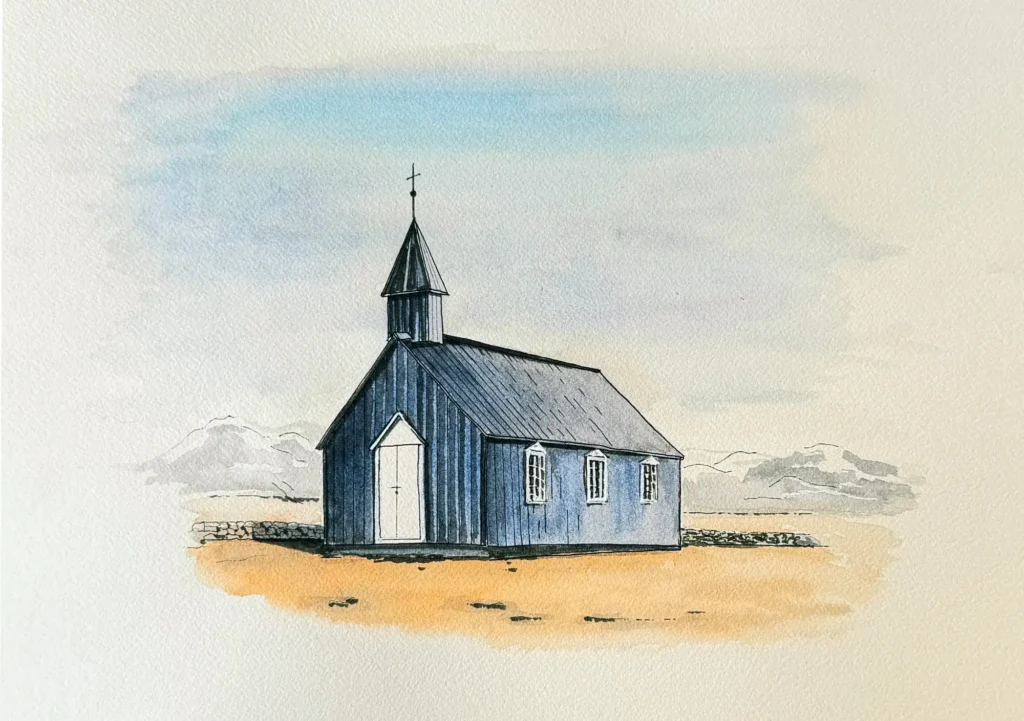
There’s a church on the Snæfellsnes Peninsula that shouldn’t exist.
In 1816, a royal letter shut it down. The trading post around it was dying, the congregation had shrunk to almost nothing, and the turf church that had stood at Búðir since 1703 was left to rot. By most measures, that was the end of the story. Churches that lose their parish don’t usually get a second chapter.
Búðir got one anyway, because a widow named Steinunn Sveinsdóttir decided she wasn’t finished with it.
SKETCH THE BLACK CHURCH. Try it out!
A church with no congregation to save it — except one person
Steinunn lived at Búðir in the mid-1800s, decades after the original turf church had already been abolished. She wasn’t a clergywoman, wasn’t wealthy in any obvious sense, and had no official reason to take this on. She applied for permission to rebuild the church anyway. When it was granted, she didn’t hand the project off — she led the construction herself and paid for it out of her own pocket.
The new wooden church was finished in 1848. It wasn’t consecrated until 1851, and Steinunn lived just three more years after that, dying in 1854 at 77. She’s buried in the churchyard she fought to bring back to life, and her gravestone is still there — close enough to the black walls that you can visit both in the same five minutes.
That’s the part of Búðakirkja most photos leave out. The image everyone shares is a small black church alone on a lava field with a glacier in the distance. It’s a striking picture. It’s also only half the story.
Why the black church still stands today
The building you see now isn’t quite the 1848 original — by the 20th century it needed real intervention. In 1987, local residents worked with specialists, including experts from the National Museum of Iceland, to restore it back to how it looked when Steinunn’s church was completed. That restoration is why Búðakirkja still reads as a 19th-century building rather than a modern reconstruction wearing old clothes.
Inside, it’s a single small room — roughly 5 by 9 metres, seating for about 50 people, an organ, two bells in the tower. No heating, no bathroom, no running water. It’s still a working parish church, used today for services, weddings, and music events, which is part of what makes it feel alive rather than preserved-in-amber.
What makes the black exterior so striking
Most Icelandic churches are white or red. Búðakirkja is tarred black from roof to walls, with only the door and window frames left white. That contrast is the whole visual identity of the place — it’s why photographers and painters keep coming back to it, and why it reads so clearly even from a distance, small and dark against the lava field and the sky.
If you’re sketching or painting it, that’s the detail worth chasing before anything else. Start with the roofline, the walls, the small tower. Get the silhouette right and the church stays recognizable even with almost nothing else added. The temptation is to render every rock in the Búðahraun lava field around it — resist that. The isolation is the composition. Leave space around the building and let the black shape do the work, with the white door and windows as the only points of light.
Búðahraun: the lava field around the church
Búðakirkja sits right beside Búðahraun, a protected lava field with unusual plant life and birdlife, and on a clear day, Snæfellsjökull glacier sits on the horizon behind it. The church doesn’t really make sense on its own — it makes sense as part of this landscape, which is why it’s worth building in time to walk the lava field rather than just pulling up, taking a photo, and leaving.
Visiting Búðakirkja ( Budier)
The church is on the southern side of the Snæfellsnes Peninsula, at Búðir. It’s a protected cultural heritage building, so access outside posted opening hours means contacting the church keeper in advance. There’s no heating or facilities inside, so dress for it and don’t plan on lingering too long once you’re in.
Búðakirkja fast facts
- First church at Búðir built: 1703 (turf construction)
- Burials at the site since: 1705
- Original church abolished: 1816
- Present wooden church completed: 1848
- Consecrated: 1851
- Built and financed by: Steinunn Sveinsdóttir
- Steinunn died: 1854, age 77, buried in the churchyard
- Restored to original appearance: 1987
- Size: approximately 5 x 9 metres, seats around 50
The five minutes worth taking
Stand back from the church for a moment before you photograph it or walk up to the door. Look at how small it actually is against that landscape. Then look at the black walls and white trim again, knowing what you know now.
In 1816, this place lost its church. It could easily have stayed that way. Instead, one woman decided a small building at the edge of a dying trading post was still worth saving, and did something about it herself.
That’s the part I try to hold onto when I sketch it — not just the shape of the church, but the stubbornness behind it.