Most people visit Macau for one reason: its casinos.
Often called the gambling capital of the world, Macau is the only place in China where casino gambling is legal. Glittering resorts, luxury hotels, and enormous gaming floors attract millions of visitors every year. It is easy to think that gambling defines the city.
I thought so too, until I wandered away from the casinos.
Just a few minutes from Senado Square, hidden among the narrow streets of the old Portuguese quarter, I found a gentle yellow church that immediately slowed my pace. It was quiet and elegant, completely different from the image of Macau that most people carry home.
That church was St. Dominic’s Church.
I first visited it in 2012, carrying nothing more than a sketchbook, a pen, and a camera. At the time, I knew very little about its history. I simply stopped because it looked beautiful. Fourteen years later, when I opened those old sketches and photographs again, I realised this small church had quietly stayed with me all those years.
Macau Beyond the Casinos
Macau is far more than a gambling destination.
For over four centuries, it was under Portuguese administration, becoming one of the earliest meeting places between Europe and China. That remarkable history still survives in its cobbled streets, pastel-coloured buildings, churches, temples, and public squares.
The Historic Centre of Macau is now recognised as a UNESCO World Heritage Site, and walking through it feels very different from walking through the casino district. Here, history unfolds slowly, one street at a time.
St. Dominic’s Church is one of the finest examples of that quieter Macau.
My First Visit
I still remember standing in Largo de São Domingos and looking carefully at the church for the first time.
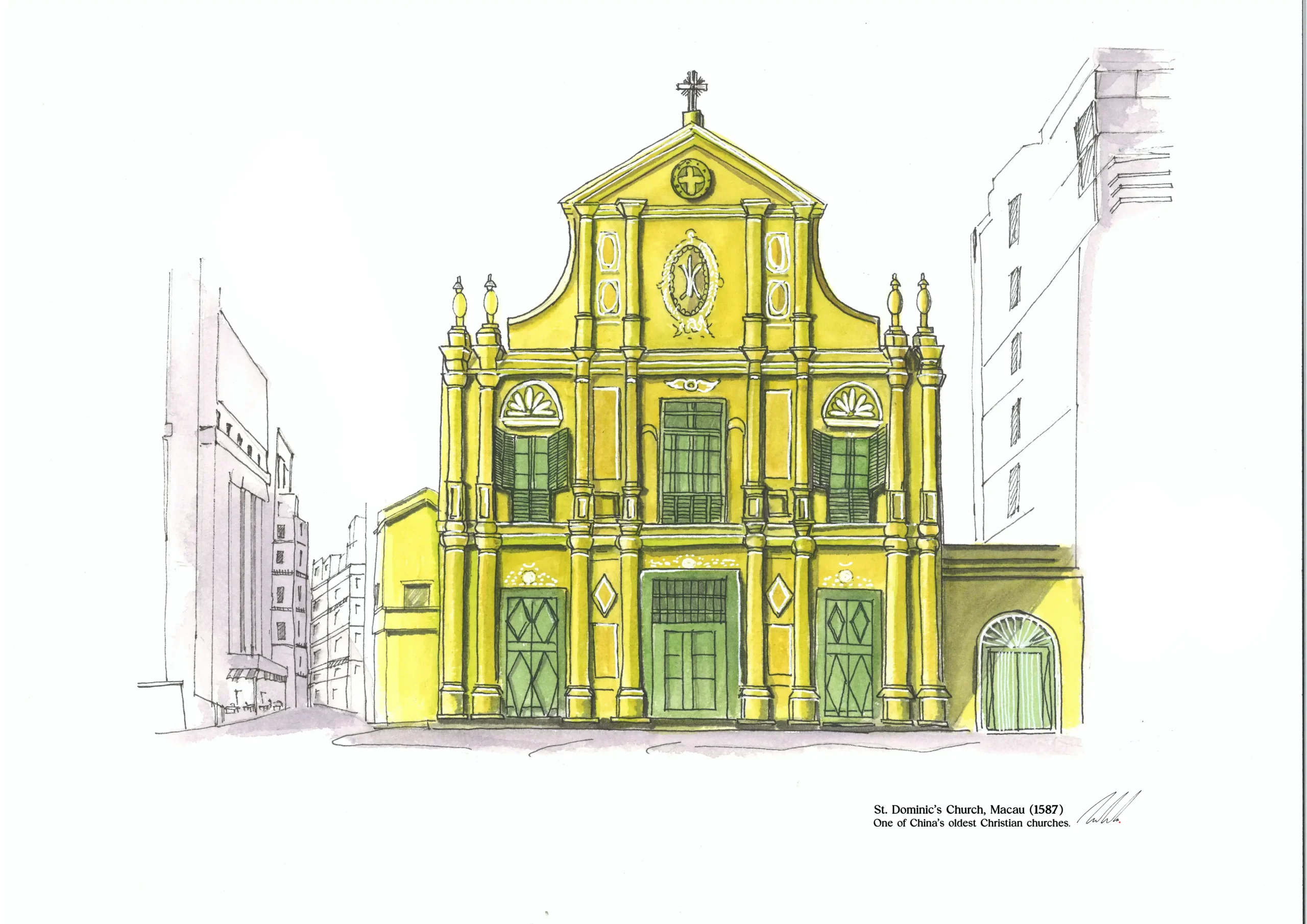
Its cream-yellow façade, white decorative details, paired columns, curved pediment, and small statues along the roofline immediately appealed to the sketcher in me. It was not an enormous cathedral. In fact, its modest size made it even more inviting.
I only had time for a few quick sketches and some reference photographs before continuing my walk through the city.
I thought I had simply recorded another beautiful building. I was wrong.
Sketching St. Dominic’s Church
When I finally decided to create a finished sketch years later, I realised this church demanded much more patience than I had expected.
The architecture is wonderfully balanced. Every column, window, and moulding depends on the proportions being correct. If the main structure is even slightly inaccurate, the entire façade feels wrong.
That challenge made the sketch especially rewarding.
My Ink and Wash Approach
I sketched the church using my usual ink and wash technique.
I always begin with waterproof ink, concentrating on the overall structure rather than the decorative details. Once the drawing feels balanced, I gradually build transparent watercolour washes over the ink.
One lesson I have learned through travel sketching is simple: draw the large shapes first. The smaller details naturally find their place afterwards.
As the sketch slowly came to life, I noticed things I had completely missed in my photographs. The warm cream walls, the crisp white trim, and the green shutters created a harmony that only became obvious after spending several hours studying the building. Sketching forces me to slow down, which is why I continue to travel with a sketchbook.
A Church Built Across the Pacific
While working on the sketch, I found myself remembering the church’s remarkable history.
St. Dominic’s Church was founded in 1587 by three Spanish Dominican priests who sailed across the Pacific from Acapulco, Mexico.
Their first church was built from timber, giving rise to its local Chinese name, Ban Zhang Tang, meaning the Church of Wooden Planks.
During the early seventeenth century, the wooden structure was rebuilt in stone, creating the elegant Baroque church that still stands today in Largo de São Domingos.
Looking carefully at the façade while sketching, I could easily see both Portuguese and Spanish influences in its design.
A Church That Has Witnessed Conflict
The peaceful appearance of the church hides a surprisingly dramatic past.
One story stayed with me throughout the sketch.
In 1644, a Spanish officer loyal to the Spanish Crown ran into the church seeking sanctuary from an angry mob. He reached the altar during Mass, hoping to find safety. He was killed there.
Standing in front of the completed sketch, it was difficult to reconcile that violent history with the calm building I had painted.
The church witnessed another important episode during the Chinese Rites Controversy in 1707.
The Dominican friars sided with the Pope against the Bishop of Macau. When soldiers arrived to enforce the Bishop’s ruling, the friars barricaded themselves inside the church for three days and even threw stones from the building to keep the soldiers outside. Eventually, they were excommunicated.
More Than a Church
Another discovery surprised me.
In 1822, St. Dominic’s Church became home to A Abelha da China (The China Bee), one of the first Portuguese-language newspapers printed on Chinese soil.
That small detail reminds us that this church contributed not only to Macau’s religious history but also to its cultural and intellectual life.
A Living Place of Faith
Despite everything it has witnessed, St. Dominic’s Church remains a living church.
It was originally built to house the statue of Our Lady of the Rosary, which still stands at the main altar today.
Every 13 May, the church becomes the starting point for Macau’s procession honouring Our Lady of Fatima. Hundreds of worshippers walk through the historic streets in a tradition that has continued for generations.
Watching faith continue in a building that has survived so many centuries adds another layer of meaning to any visit.
Visiting St. Dominic’s Church
If you are planning a trip to Macau, St. Dominic’s Church is easy to include in your itinerary.
It stands in Largo de São Domingos, only a short walk from Senado Square and about fifteen minutes on foot from the Ruins of St. Paul’s.
If you have time, visit the small museum inside the bell tower. It houses paintings, sculptures, and sacred objects connected with the church’s history.
Morning is my favourite time to visit. The softer light brings out the warm colours of the façade, and the square is usually quieter before the crowds arrive.
The church is also one of the twenty-nine monuments that together form the Historic Centre of Macau, recognised as a UNESCO World Heritage Site.
What This Sketch Means to Me
When I finished this sketch, I realised I had done much more than draw another church. I had revisited a journey I made fourteen years earlier.
Every line of ink brought back another memory. Every wash of colour reminded me why I enjoy slowing down with a sketchbook instead of rushing through places with a camera.
That is really what Church Sketchbook is about: a way of travelling more slowly, observing more carefully, and discovering the stories hidden behind remarkable churches around the world.
If you would like to watch this sketch come to life, you can watch the accompanying Church Sketchbook video below. You can also download the reference photographs, printable sketch outline, church fact sheet, and prayer card using the links on this page.
Sometimes the most memorable place in a city famous for gambling is not a casino. Sometimes it is a quiet yellow church that has been patiently telling its story for more than four centuries.
DOWNLOAD FACT SHEET + COLOURING PAGE + PRAYER CARD