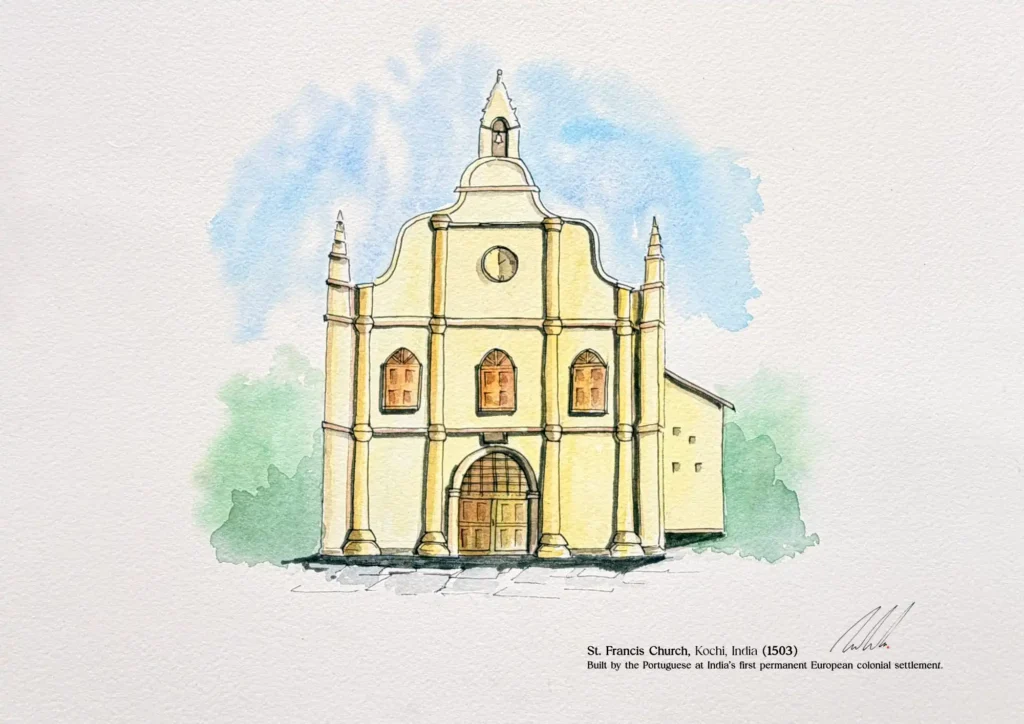
Nearly forty years ago, I walked through the narrow streets of Fort Kochi as a curious young traveller. I knew very little about history then. The old buildings, the Chinese fishing nets, and the quiet church seemed interesting enough, but I had no idea I was standing at a place that changed the course of Asian history.
That church was St. Francis Church.
I have returned many times since that first visit. Every visit shows me something I missed before. These days, when I sit with my sketchbook under its plain tiled roof, I no longer see just an old building. I see where a much bigger story begins.
A Church Built for Jesus, Spices and Malabar
St. Francis Church was built in 1503 by Portuguese Franciscan friars, and it’s widely considered the oldest surviving European church in India. The first version was timber, rebuilt later in stone. Unlike the elaborate churches the Portuguese would go on to build in Goa, this one was practical. Plain walls, a timber roof, an airy interior built for the Malabar heat, not for grandeur. It served traders, sailors, and missionaries who needed a place to pray, not a monument.
The church has worn several names, and each change marks a shift in who controlled Kochi. It started out dedicated to St. Bartholomew. When the Dutch took Kochi in 1663, they turned it Protestant and altered the interior. The British arrived in 1795 and made it Anglican. After the Church of South India formed in 1947, it joined that fold, and it still holds services today.
Not many buildings carry the fingerprints of three different empires under one roof.
Vasco da Gama’s Grave, and a Church on the Missionary Route
One of the church’s best known connections is to Vasco da Gama. He died in Kochi in 1524 and was buried here, his remains only moved back to Portugal fourteen years later. The original grave marker is still there, a strange thing to stand next to when you consider how much history that one name carries.
Francis Xavier passed through Kochi too, during his years travelling across Asia as a missionary. He’s remembered more for Goa and the Pearl Fishery Coast, but Kochi was one of his stops, which places this small church inside a much wider map of Christianity’s spread through Asia.
But this building was never only about religion.
A Trading Post That Became a Doorway to Colonial Rule
Standing here, I keep coming back to what else arrived along with the ships. Trade came first. Then diplomacy, competition, military presence, and eventually full colonial control. The Portuguese opened the door. The Dutch pushed them out. The British came after both and slowly extended their grip across the subcontinent.
This modest church ended up as one of the earliest markers of that shift. History rarely starts with a battle. More often it starts with a trading post, a place of worship, and a handful of people who had no idea how much their world was about to change.
India’s freedom struggle eventually closed that chapter, but buildings like this one matter because they let us trace the whole arc, faith, trade, exploration, conflict, and what came after. They don’t need to say a word to tell you all of that.
As an artist, sketching forces me to slow down enough to notice these layers. Every line pulls my attention somewhere new. I find myself picturing the sailors who prayed here before crossing the Indian Ocean, the local craftsmen who actually built these walls, the missionaries passing through, and the ordinary people of Kochi who watched one flag after another rise over the town.
This church is more than a heritage site on a map. It’s a doorway into how modern India came to be, and for me, it’s also the place where a young traveller’s curiosity, first sparked almost forty years ago, slowly turned into a lifelong habit of looking closely and sketching what I find.
Visiting St. Francis Church: What Travellers Should Know
If you’re a Western tourist planning a trip to Kerala, Fort Kochi is an easy place to fall in love with, and St. Francis Church deserves more than a five minute stop.
- Why it’s worth your time: it’s not just old, it’s a physical record of Portuguese, Dutch, and British rule layered on top of each other, which is rare to see in one small building.
- Pair it with the neighbourhood: the church sits close to the Chinese fishing nets and the old Dutch and Portuguese quarter, so you can cover a lot of history on foot in a couple of hours.
- Go in the early morning: Fort Kochi gets warm and crowded by midday, and the light inside the church is better for photos before 10 am.
- Dress modestly: it’s still an active place of worship, so cover your shoulders and knees out of respect.
- Look for Vasco da Gama’s grave marker: it’s easy to miss if you’re not looking down near the altar area.
- Bring a guide or do a little reading first: the church itself has minimal signage, so the history isn’t handed to you on a plate, you get more out of it if you already know what you’re looking at.
DOWNLOAD ST FRANCIS CHURCH FACT SHEET AND COLOURING PAGE NOW